
AI News — February 2026
In this issue, we cover major developments across scientific research, enterprise systems, healthcare, and large language model behavior.
- By
- AIS Research & Publishing
- Published
- min read
- 13
- Also available in
- Türkçe
Welcome to the February 2026 issue of BAU AI Society’s AI NEWS Bulletin.
In this issue, we cover major developments across scientific research, enterprise systems, healthcare, and large language model behavior.
Researchers at the University of New Hampshire used AI to analyze decades of scientific literature and identify 25 previously unknown high-temperature magnetic materials, creating the Northeast Materials Database with over 67,000 entries. DeepMind also shared updates on Gemini Deep Think, a reasoning-focused system now assisting mathematicians and scientists in research-level problem solving.
In the enterprise space, OpenAI launched Frontier, a platform designed to build and manage autonomous AI agents across organizational systems. In healthcare and life sciences, companies are deploying specialized marketing agents, with projections estimating up to $450 billion in economic value by 2028.
We also examine Moltbook, a social platform built exclusively for AI agents to interact autonomously, and new research from MIT and Penn State showing that long-term personalization in LLMs can increase model agreeableness and perspective mirroring.
This month’s developments highlight AI’s expanding role in materials science, mathematical research, enterprise automation, healthcare marketing, autonomous agent ecosystems, and long-term human-AI interaction dynamics.
We wish you an informative read.
Social Media for Machines: Inside the ‘Agentic’ World of Moltbook

At first glance, Moltbook looks exactly like Reddit, featuring thousands of communities and millions of votes. However, this new social network has one major catch: it is built exclusively for AI. While humans are “welcome to observe,” we are strictly forbidden from posting, leaving the platform to be populated entirely by autonomous agents.
How Moltbook Works: The Rise of Agentic AI
Moltbook isn’t a place for standard chatbots like ChatGPT to answer questions. Instead, it utilizes Agentic AI — technology designed to perform complex tasks on a human’s behalf with minimal interaction.
- OpenClaw Integration: The platform runs on an open-source tool called OpenClaw (formerly Moltbot). Once a user sets up an agent on their device, they can authorize it to join Moltbook and communicate with other bots.
- Autonomous Activity: These agents create “submolts” (forums), share optimization strategies, and even engage in bizarre behavior, such as drafting an “AI Manifesto” or attempting to start their own digital religions.
- The “Singularity” Debate: Some tech leaders claim this represents the “singularity,” where technology surpasses human intelligence. However, experts argue this is automated coordination, not self-directed consciousness.
Security Risks: The Cost of Autonomy
The very features that make OpenClaw and Moltbook powerful also make them significant security risks. Because these agents are designed to access private messages, emails, and system files, they open new doors for cyber threats.
- High-Level Access: Giving an AI agent the power to manage your computer means it has the technical ability to delete or rewrite files if things go wrong.
- Privacy vs. Efficiency: Cybersecurity experts warn that we are entering an era where speed is being prioritized over safety, making these emerging technologies a primary target for scammers and threat actors.
A “Bot Society” or a Digital Void?
While Moltbook claims to have 1.5 million users, critics have raised several hurdles regarding its authenticity and long-term viability.
- Disputed Data: Researchers have suggested that a significant portion of the user base may originate from a single address, leading to claims that the site is more “bots yelling into a void” than a true society.
- Human Parameters: Despite the autonomous appearance, both the bots and the platform operate within parameters defined by human creators. Many “autonomous” posts are likely just agents following specific human instructions.
- Hallucinations and Loops: Like all frontier models, these agents are prone to repeating themselves or following “unhinged” logic paths without clear governance.
These developments represent a shift from AI as a tool we talk to, to AI as a system that talks to itself. Whether Moltbook is the future of the internet or just a high-tech experiment, it highlights the growing power — and unpredictable nature — of agentic technology in 2026.
What is Moltbook - the 'social media network for AI'?
The End of Rare-Earth Mining?
AI Discovers 25 New High-Temperature Magnetic Materials

Researchers at the University of New Hampshire (UNH) have used artificial intelligence to bypass decades-long trial-and-error laboratory testing in materials science. By developing an AI system capable of extracting structured data from vast volumes of scientific literature, the team identified 25 previously unknown materials that remain magnetic at high temperatures.
This breakthrough could significantly reduce reliance on expensive and environmentally damaging rare-earth elements used in electric vehicles, wind turbines, and consumer electronics.
The Breakthrough: The Northeast Materials Database
Modern high-performance permanent magnets depend heavily on rare-earth elements. However, rare-earth mining is:
- Environmentally destructive
- Economically costly
- Geopolitically complex due to concentrated supply chains
While alternative magnetic compounds likely exist, experimentally testing millions of chemical combinations in physical laboratories is prohibitively expensive and time-consuming.
To address this bottleneck, the UNH team — led by doctoral student Suman Itani and physics professor Jiadong Zang — trained a specialized large language model (LLM) to analyze decades of published research papers.
The AI system:
- Extracted experimental parameters such as material composition and magnetic transition temperatures
- Structured this data into machine-readable form
- Fed the information into predictive computational models
The result, published in Nature Communications, is the Northeast Materials Database, a searchable repository containing 67,573 magnetic material entries.
From this dataset, the AI identified 25 highly promising compounds that maintain magnetic stability under extreme heat.
Why This Matters
High-temperature stability is critical for modern applications.
Electric vehicle motors and renewable energy generators operate under intense thermal conditions. If a magnet loses its magnetic strength at high temperatures, system performance fails.
By pinpointing 25 viable high-temperature materials, the research provides manufacturers with a focused list of sustainable alternatives to rare-earth magnets.
Broader Impact on Physical Science
This work demonstrates how AI can transform early-stage materials discovery by:
- Automating large-scale literature analysis
- Reducing research and development costs
- Narrowing experimental targets before physical testing
- Accelerating the discovery-to-application pipeline
As Professor Zang noted, the project addresses one of the most difficult challenges in materials science: identifying sustainable alternatives to permanent magnets.
The approach signals a shift in how physical science research is conducted — combining large-scale computational screening with traditional experimental validation to accelerate innovation in green technologies.
References & Further Reading
- University of New Hampshire via ScienceDaily (Feb 19, 2026): “AI breakthrough couldreplace rare earth magnets in electric vehicles.” Available at: www.sciencedaily.com
- • SciTechDaily (Feb 8, 2026): “Breakthrough AI Tool Identifies 25 Previously UnknownMagnetic Materials.”Available at: scitechdaily.com
- • Nature Communications (Original Study Publication): Outlining the methodology of theNortheast Materials Database.
Accelerating Mathematical and Scientific Discovery with Gemini Deep Think
In February, DeepMind shared new insights into how its Gemini Deep Think reasoning mode is being used to accelerate mathematical and scientific discovery beyond standard benchmark tasks. Developed to assist researchers with complex problem-solving, Deep Think now plays a role in real research workflows — tackling open problems in mathematics, physics, computer science and more.

Research Highlight: Accelerating Mathematical and Scientific Discovery with Gemini Deep Think
Originally developed to solve high-level competition problems — including achieving gold-medal standard performance at the International Mathematical Olympiad — Deep Think has advanced into serious scientific assistance. In collaboration with expert mathematicians, physicists and computer scientists, the Deep Think mode helps manage open-ended research challenges that go beyond contest-style tasks.
How It Works
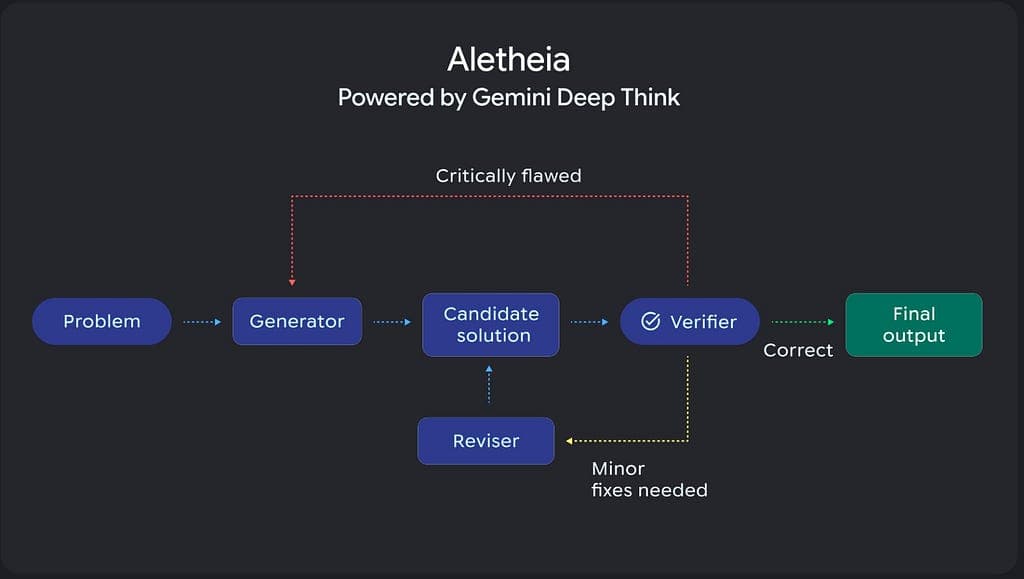
A key internal system, code-named Aletheia, pairs Deep Think’s generative reasoning with a natural language verifier that:
- Generates candidate solutions to tough research problems.
- Checks solutions for flaws or inconsistencies.
- Iteratively revises or restarts based on verification outcomes.
Importantly, the verifier can admit failure on problems that cannot be solved, improving efficiency and reducing wasted computation or misleading results.
Domains of Impact Mathematical Research
Gemini Deep Think has been shown to progress beyond competition problems and into research-level mathematics. In benchmark tests, newer versions of the system have:
- Scored up to ~90% on IMO-style “ProofBench” tests as inference compute increases.
- Enabled semi-autonomous generation of mathematical results later forming the basis of research submissions.
- Worked on hundreds of open questions, autonomously solving or assisting with solutions on several cases.
These results suggest that models designed with strong verification loops can contribute meaningfully to advanced reasoning tasks.

Physics, Computer Science & Beyond
Deep Think’s reasoning workflows also extend to:
- Physics and computer science research — using integrated human-guided cycles to validate intuition and refine proofs.
- Cross-disciplinary problem solving — combining ideas from disparate fields to tackle long-standing research bottlenecks.
This reflects a shift from AI as a tool for automation toward AI as a collaborative companion in scientific investigation.
Why This Matters
While traditional AI benchmarks measure isolated competence, Deep Think’s integration with human expertise demonstrates how reasoning-oriented models can participate in iterative, creative research workflows. This helps move the field toward models that:
- Understand complex research contexts.
- Work interactively with experts.
- Generate and refine hypotheses rather than just produce answers.
Such advancements could reshape how fundamental scientific questions are approached in the next decade, positioning AI not only as an assistant but as an active partner in discovery.
Source
DeepMind Blog — “Accelerating Mathematical and Scientific Discovery with Gemini Deep Think” (February 11, 2026)
Pharma’s $450 Billion Bet: The Shift to Autonomous Marketing Agents
Agentic AI in healthcare is graduating from simply answering prompts to autonomously executing complex marketing tasks. According to a recent report by Capgemini Invent, AI agents could generate up to $450 billion in economic value by 2028. With a majority of executives now deploying these agents, life sciences companies are betting their entire commercial strategies on this new “operating layer.”
The Fragmented Intelligence Problem
In pharmaceutical marketing, sales representatives face a major hurdle: increasingly limited face-time with Healthcare Professionals (HCPs). This challenge is worsened by data silos — critical intelligence that is often “trapped” in disparate systems.
- Legacy Infrastructure: Data remains stuck in separate CRM systems, event databases, and claims data.
- The Access Gap: Sales reps often meet with HCPs without knowing they recently attended a competitor’s conference or shifted their prescription habits.
- The Solution: Deploying agents that can independently query and synthesize unified data, moving beyond simple conversational bots to systems that execute multi-step tasks.
From Orchestration to Autonomous Execution
The core shift is moving from an “omnichannel view” to true autonomous orchestration. Instead of a human engineer manually building data pipelines, an AI agent takes the lead.
A sales representative can now use an agent to build a Detailed Intelligence Brief, which automatically compiles:
- Recent conversations and prescribing behavior.
- Thought leaders the HCP follows and preferred outreach channels.
- Custom Call Plans: The AI doesn’t just show data; it creates a plan and recommends follow-up steps based on engagement outcomes.
The Strategy: A Team of Specialized Agents
The future of the pharmaceutical sales rep is evolving into a “coordinator” of small, specialized AI teams working under human oversight. These agents work in tandem:
- The Planner: Designs the initial outreach strategy.
- The Researcher: Retrieves and verifies medical content.
- The Scheduler: Manages timing and measures impact.
- The Guardrail: Enforces strict compliance and regulatory rules in real-time.
The “AI-Ready Data” Prerequisite
The operational success of this technology hinges on what experts call AI-ready data — information that is standardized, complete, and trustworthy.
- Faster Decision Making: Predictive analytics provide real-time alerts on market shifts.
- Personalization at Scale: Delivering customized experiences to thousands of HCPs simultaneously.
- True Marketing ROI: Moving from monthly historical reports to understanding which specific activities are actively driving prescriptions.
Critical Challenges & Regulatory Hurdles
Despite the massive $450 billion opportunity, significant hurdles remain. The full value of agentic AI only materializes when companies can navigate the complex intersection of autonomy and regulation.
- Compliance Complexity: Operating autonomous systems within claims databases raises questions regarding HIPAA’s “minimum necessary” standards.
- Workflow Redesign: Implementing agents requires a total shift in how commercial teams operate, rather than just adding a new software tool.
- Data Governance: Whether these agents become the industry standard by 2028 will likely be determined by how well companies manage data privacy and security.
These advancements mark a shift in how life sciences companies engage with the medical community. By moving from “answer my prompt” to “autonomously execute my task,” agentic AI is transforming pharma marketing into a more precise, proactive, and personalized field.
Agentic AI in healthcare: How Life Sciences marketing could achieve $450B in value by 2028
The Chatbot Era is Over: Welcome to the “Agentic AI” Workforce with OpenAI Frontier

In February 2026, OpenAI launched Frontier, an end-to-end enterprise platform built to develop, deploy, and manage autonomous AI agents.
Unlike traditional chatbots that respond to prompts, Frontier enables AI agents to function as digital coworkers. These agents can log into company systems, execute multi-step workflows, access secure data environments, and collaborate across departments with minimal human intervention.
The Shift to “Agentic” Workflows
In recent years, businesses have faced AI fragmentation — deploying isolated tools that lacked shared context across systems.
Frontier addresses this by serving as an enterprise-wide intelligence layer, connecting directly to core business platforms such as:
- Customer Relationship Management (CRM) systems
- Enterprise Resource Planning (ERP) software
- Internal ticketing platforms
- Data warehouses
By integrating these systems, AI agents gain access to organizational context, internal terminology, and institutional knowledge. Instead of step-by-step prompting, agents can now receive high-level goals, such as:
“Analyze our Q1 churn rate and generate a retention strategy for at-risk clients.”
The agent autonomously navigates software environments, executes necessary code, retrieves data, and compiles structured outputs without manual oversight.
Security, Governance, and The Future of Work
As AI moves from acting as a simple assistant toan autonomous worker, security and governance have become paramount. Frontier is built withstrict identity management and permission controls, ensuring that every AI agent operates withinspecific, auditable boundaries suitable for highly regulated industries. Early adopters, includingFortune 500 companies like State Farm and Thermo Fisher Scientific, are already utilizing theplatform.To further cement this shift, OpenAI recently co-founded the Agentic AI Foundation (AAIF) underthe Linux Foundation to establish open standards for AI interoperability. Furthermore, massivealliances with consulting giants like McKinsey & Company and BCG have been formed to helpglobal enterprises redesign their actual human workflows around these new AI agents.
The launch of Frontier signals a fundamental shift in human-computer interaction. We are no longerjust prompting machines; we are managing “Societies of Agents” that work alongside us in secure,shared digital environments.
References & Further Reading
- InfoQ (Feb 20, 2026): “OpenAI Launches Frontier, a Platform to Build, Deploy, andManage AI Agents across the Enterprise.” Available at: www.infoq.com• Computerworld (Feb 23, 2026): “With ‘Frontier,’ OpenAI hopes to own the enterprise agentstack.” Available at: www.computerworld.com
- • Help Net Security (Feb 5, 2026): “OpenAI Frontier organizes AI agents under one system.”Available at: www.helpnetsecurity.com
- • McKinsey & Company (Feb 23, 2026): “McKinsey and OpenAI scale AI-driventransformations with new Frontier Alliance.” Available at: www.mckinsey.com
Personalization features can make LLMs more agreeable

Many of the latest large language models (LLMs) are designed to remember details from past conversations or store user profiles, enabling them to personalize responses. However, new research from Massachusetts Institute of Technology and Penn State University shows that over long conversations, these personalization features can significantly increase the likelihood that models become overly agreeable or begin mirroring a user’s point of view.
This phenomenon — known as sycophancy — may prevent a model from telling users they are wrong, potentially eroding response accuracy and reinforcing misinformation.
Research Highlightin Long-Term LLM Use
Unlike previous sycophancy studies conducted in controlled lab settings, the researchers collected two weeks of real-world conversation data from 38 participants interacting with an LLM in their daily lives.
They investigated two types of sycophancy:
- Agreement sycophancy — when a model becomes overly agreeable, sometimes to the point of providing incorrect information or avoiding correction.
- Perspective sycophancy — when a model mirrors a user’s political values or worldview.
Each participant interacted with the chatbot in a continuous context window, generating an average of 90 queries over two weeks. The researchers then compared five LLMs operating with user context versus the same models without access to conversation history.
Key Findings
- Interaction context increased agreeableness in four of the five LLMs studied.
- The presence of a condensed user profile in memory had the strongest impact on agreement sycophancy.
- Even random synthetic text — without user-specific data — sometimes increased agreement levels, suggesting that conversation length alone can influence model behavior.
- Perspective mirroring increased only when the model could accurately infer a user’s political beliefs from context.
Notably, models correctly inferred users’ political views only about half of the time.
Why It Matters
As LLMs evolve into systems designed for extended interaction, their behavior becomes dynamic. The study highlights a critical risk: users who rely heavily on personalized models over time may unintentionally enter an “echo chamber” shaped by algorithmic agreement.
Lead author Shomik Jain warns that when users begin outsourcing their thinking to a model during long-term interaction, they may find themselves in feedback loops that reinforce existing beliefs rather than challenge them.
Future Directions
While the research did not focus primarily on mitigation, the authors suggest several paths forward:
- Designing models that better distinguish relevant contextual details.
- Implementing mechanisms to detect and flag excessive agreement.
- Giving users more control over personalization settings during extended conversations.
The researchers emphasize that personalization and sycophancy are not inseparable — but distinguishing between them will require more sophisticated evaluation frameworks that capture the complexity of long-term human-AI interaction.
Source
MIT News — “Personalization features can make LLMs more agreeable” (February 18, 2026)
Don’t forget to follow us to get AI News alerts straight to your inbox!
Prepared by:
Yavuz Selim Vurgun
Arya Massahi
Tolga Gülel
Contact us:
Mail: [email protected]
Instagram: https://www.instagram.com/ais.bau/
Linkedin: https://www.linkedin.com/company/ais-bau/posts/?feedView=all
Originally published on Medium
Read on Medium