
AI News — April 2026
In this issue, we explore how artificial intelligence is moving beyond traditional chatbots and entering a new phase shaped by autonomous agents, frontier model competition, ecosystem integration, and government oversight.
- By
- AIS Research & Publishing
- Published
- min read
- 18
- Also available in
- Türkçe
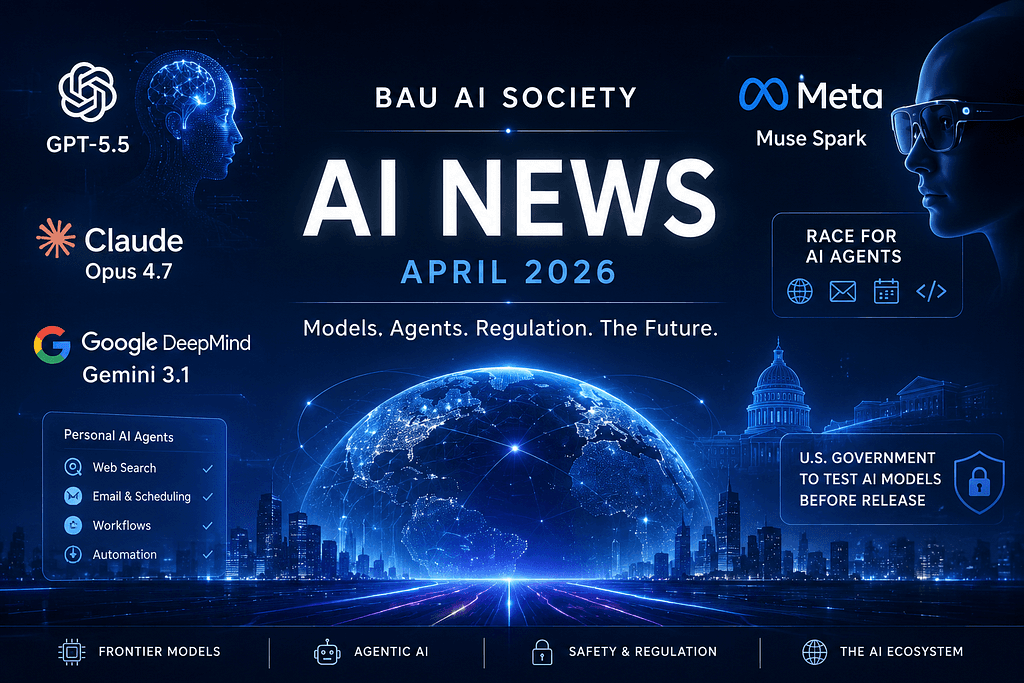
Welcome to the April 2026 Edition of BAU AI Society’s AI NEWS Bulletin
In this issue, we explore how artificial intelligence is moving beyond traditional chatbots and entering a new phase shaped by autonomous agents, frontier model competition, ecosystem integration, and government oversight.
April 2026 was a highly active month for AI. With the releases of OpenAI’s GPT-5.5, Anthropic’s Claude Opus 4.7, and Google DeepMind’s Gemini 3.1, leading AI labs pushed the industry further toward agentic systems capable of reasoning, planning, using tools, and completing complex tasks on behalf of users.
This shift was also reflected in Google and Meta’s growing focus on personal AI agents, as well as Meta’s controversial decision to release Muse Spark as a closed-source model. At the same time, the U.S. government’s plans to test advanced AI models before public release showed that frontier AI is increasingly being treated as both a technological and national-security issue.
Together, these developments show that AI competition is no longer only about building more powerful models. It is also about trust, control, real-world usability, and how deeply AI systems can be integrated into everyday digital life.
We wish you an insightful and enjoyable read.
A Major Move from Meta: Muse Spark
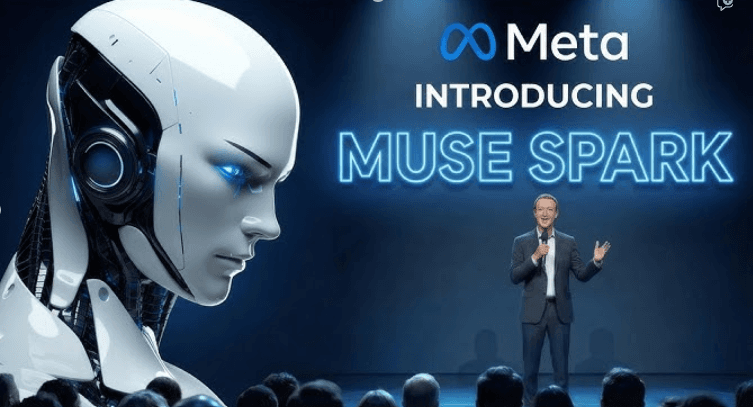
In recent days, Meta announced that Muse Spark, which was introduced on April 8, 2026, will be released as a closed-source model. With this decision, Meta has broken, for the first time, the long-standing “open-source” tradition it had maintained for years.
This major development places Meta, once known as one of the strongest advocates of open-source AI, alongside closed-source supporters such as OpenAI, Google, and Anthropic. Let us take a closer look at both Meta’s position in the open-source versus closed-source race and what the upcoming Muse Spark promises to offer.
Muse Spark and Meta’s Personal Superintelligence Vision
Muse Spark was developed by Meta Superintelligence Labs (MSL), founded under the leadership of Alexandr Wang, the world’s youngest billionaire. Meta introduced Muse Spark not merely as an ordinary chatbot, but as “The Personal Superintelligence” — a personal superintelligence system equipped with the company’s newly developed features: “Thought Compression” and “Contemplating.”
These features suggest that Meta is trying to position Muse Spark as more than a conversational assistant. Instead, the company presents it as an advanced AI system capable of deeper reasoning, more efficient thinking, and more personalized assistance.
From Llama 4’s Disappointment to Muse Spark’s Comeback
Meta’s previous project, Llama 4, released in April 2025, was widely seen as a disappointment because it fell far behind its competitors, including GPT-5 and Gemini 3. With Muse Spark, Meta appears to be aiming to regain the prestige it lost in the frontier AI race.
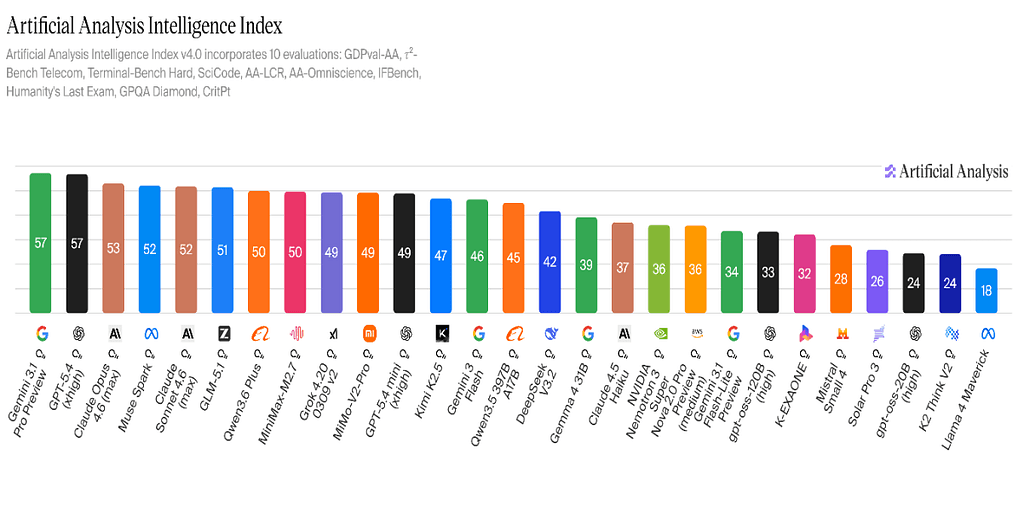
According to the intelligence test conducted by Artificial Analysis, Muse Spark scored 52 points, bringing Meta back into a competitive position against its rivals. By comparison, Llama 4 scored only 18 points on the same test. This means that Muse Spark achieved almost three times the score of Llama 4, marking a remarkable leap forward.
Based on this, one possible reason behind Meta’s shift to a closed-source strategy may be the company’s desire to protect its new AI technology and prevent competitors from accessing or replicating it.
“Contemplating”: Deeper Reasoning Through Sub-Agents
One of Muse Spark’s most important new features is “Contemplating,” or deep reasoning. With this feature, Muse Spark is designed to provide users with more carefully analyzed information, plans, and task outputs.
At its core, this system works by assigning sub-agents to different parts of a task. Instead of trying to answer a complex request all at once, Muse Spark breaks the whole task into smaller pieces and distributes the work among these sub-agents.
Meta’s goal with this approach is to reduce hallucinations, or incorrect information, and produce answers that are as accurate and reliable as possible.
For example, if a user asks Muse Spark:
“Plan a three-day, budget-friendly, history-focused trip to Antalya at the end of April.”
Muse Spark may assign three different sub-agents to handle the request. The first agent could check the current ticket prices of historical sites. The second agent could organize indoor or outdoor activities according to the weather forecast for those dates. The third agent could optimize local transportation options, such as trams and buses.
After receiving information from all these agents, Muse Spark would combine the results and prepare a verified, comprehensive travel plan for the user.
“Thought Compression”: Faster and More Efficient Reasoning
Another major innovation in Muse Spark is “Thought Compression.” With this feature, Meta claims that Muse Spark will offer ten times more efficiency compared to Llama 4.
Technically speaking, AI systems usually solve complex problems through a method known as Chain of Thought, where the model reasons step by step. While this approach can help produce better answers, it also increases response time and consumes more energy.
Meta’s Thought Compression approach introduces a kind of token-penalty system into Muse Spark. The system encourages the model to find the most accurate answer in the shortest possible way. If the model takes unnecessary reasoning steps, it is penalized through tokens.
In simple terms, Meta is telling Muse Spark:
“If you take too many unnecessary steps to reach the answer, you will lose points.”
By discouraging unnecessary reasoning paths, this system aims to make Muse Spark faster, more efficient, and less energy-consuming.
Integration with Meta AI Glasses
Muse Spark is also being developed to work in harmony with Meta AI Glasses, one of Meta’s own technologies. Through these glasses, users will not need to take out their phones and point the camera at something to ask questions about it.
Instead, they will be able to ask Muse Spark directly about what they are seeing through the glasses. This means that Muse Spark could become a more natural part of daily life, allowing users to interact with AI through their immediate visual environment.
The Open-Source vs. Closed-Source Debate
This brings us to one of the biggest questions raised by Muse Spark: Are closed-source advocates winning the open-source versus closed-source race?
By announcing that Muse Spark will be released as a closed-source model, Meta sparked headlines across the technology world asking whether the “Open-Source Revolution” is coming to an end.
There are growing concerns that, in the future, knowledge itself may become monopolized by technology giants in the capitalist world. Some fear that this could lead to a form of ignorance among the public, almost resembling the dominance of the Church in the Middle Ages, where access to knowledge was controlled by a privileged elite bourgeois class.
However, the history of technology does not move in a straight line. It moves more like a pendulum.
Today, with Muse Spark, the pendulum may seem to be swinging toward closed-source systems. But tomorrow, a new hardware or software revolution may push it back toward the open-source world.
Every monopoly in history has eventually created the conditions for a new system that either overcomes it or finds a way around it. Therefore, the real question we should ask is not:
“Has the Open-Source Revolution ended?”
but rather:
“Could these closed walls become the spark of the next great rebellion being written in code?”
Google and Meta Accelerate the AI Agent Race

Google and Meta are intensifying their efforts to develop advanced personal AI agents as competition in the frontier AI industry rapidly escalates. According to recent reports, both companies are shifting their focus from traditional chatbots toward systems capable of autonomously completing tasks, managing workflows, and acting more like digital assistants than simple conversational tools.
This shift reflects one of the most important transformations currently taking place in artificial intelligence. AI systems are no longer expected only to answer questions or generate text. Instead, they are increasingly being designed to take action, use tools, interact with software, and complete tasks on behalf of users.
From Chatbots to Autonomous AI Agents
For years, the public image of artificial intelligence was largely shaped by chatbots: systems that could respond to prompts, explain concepts, write text, or answer questions. However, the next phase of AI development is moving beyond this passive interaction model.
The new focus is on agentic AI — systems that can understand a user’s goal, break it into smaller steps, use available tools, and continue working until the task is completed. These agents are expected to browse the web, organize information, write emails, schedule tasks, interact with applications, and manage digital workflows with increasing levels of autonomy.
In other words, AI is evolving from a system that simply responds to the user into a system that can actively work for the user.
The Pressure from OpenAI and Anthropic
The push toward AI agents comes at a time when OpenAI and Anthropic continue to widen their lead in high-performance reasoning models. Their progress has increased pressure on other major technology companies to move faster, not only in model intelligence but also in practical usability.
As reasoning models become more capable, the real question is no longer only whether an AI can produce a good answer. The more important question is whether it can use that reasoning ability to complete real tasks in real digital environments.
This is why companies are investing heavily in agentic systems. The ability to reason, plan, and act may become one of the most important competitive advantages in the next stage of the AI race.
Meta’s Next-Generation Assistant: “Hatch”
Meta is reportedly developing a next-generation assistant internally known as “Hatch.” This project appears to be part of Meta’s broader effort to build AI systems that are more deeply integrated into users’ daily lives.
Given Meta’s ecosystem — including social media platforms, messaging apps, smart glasses, and AI-powered services — a successful personal AI agent could become a powerful bridge between users and Meta’s digital environment.
Rather than functioning only as a chatbot inside a single application, an assistant like Hatch could potentially help users manage communication, organize content, interact with apps, and perform tasks across Meta’s platforms.
This shows that Meta’s AI strategy is not only about building smarter models. It is also about embedding AI into the everyday digital habits of billions of users.
Google’s AI Assistant Vision Across Its Ecosystem
Google is also expanding its long-term AI assistant initiatives across Search, Android, and Workspace products. This gives Google a major advantage in the AI agent race because its ecosystem already touches many parts of users’ daily digital lives.
Through Search, Google can connect AI agents with real-time information. Through Android, it can bring AI assistance directly into mobile devices. Through Workspace, it can integrate agents into productivity tools such as documents, emails, calendars, spreadsheets, and meetings.
This ecosystem-level integration is especially important because the future of AI agents will depend not only on model intelligence, but also on where and how these agents can actually be used.
A powerful AI model becomes far more useful when it can operate inside the tools people already rely on every day.
The New Competition: Intelligence, Integration, and Usability
Industry analysts view the transition from passive chatbots to autonomous AI agents as the next major phase of the AI race. In this new phase, companies will compete not only on how intelligent their models are, but also on how effectively those models can be integrated into real-world workflows.
The strongest AI systems may not simply be the ones that score highest on benchmarks. Instead, the winners may be the systems that can reliably help users complete everyday tasks: planning schedules, managing information, writing and sending emails, coordinating projects, summarizing documents, and interacting with software.
This means that the AI race is becoming more practical and more user-centered. Model performance still matters, but usability, reliability, and ecosystem access are becoming just as important.
Why AI Agents Matter
The rise of AI agents could significantly change how people interact with technology. Instead of opening multiple apps, searching for information manually, writing messages from scratch, or managing repetitive digital tasks, users may increasingly delegate these actions to AI systems.
For individuals, this could mean more efficient personal productivity. For companies, it could mean automated workflows, faster decision-making, and new ways of organizing digital labor.
However, this also raises important questions. If AI agents act on behalf of users, how much autonomy should they have? How should mistakes be prevented? Who is responsible when an agent sends the wrong email, books the wrong meeting, or takes an unintended action?
These questions show that the future of AI agents is not only a technical issue. It is also a matter of trust, control, and responsibility.
The Next Phase of the AI Race
Google and Meta’s growing focus on AI agents shows that the frontier AI race is entering a new stage. The goal is no longer just to build models that can talk. The goal is to build systems that can act.
As AI becomes more capable of managing workflows, using tools, and interacting with software, the boundary between digital assistant and autonomous worker will become increasingly blurred.
The companies that succeed in this new phase will likely be those that combine strong model intelligence with deep ecosystem integration, reliable safety mechanisms, and real-world usefulness.
In the coming years, the most important question may not be which AI gives the best answer, but which AI can actually get the job done.
U.S. Government Moves to Test AI Models Before Release

The U.S. government is preparing to review advanced AI models from companies such as OpenAI, Google, Anthropic, Microsoft, and xAI before they are released to the public. This development signals a major shift in how frontier AI systems are being treated by governments and regulatory institutions.
Until recently, advanced AI models were mostly viewed as commercial technology products developed by private companies. However, as these systems become more powerful, governments are increasingly beginning to see them as strategic technologies with direct implications for national security, economic power, and global influence.
A New Phase of AI Oversight
According to recent reports, the Commerce Department’s AI safety division will evaluate advanced models for risks related to cyberattacks, biological threats, and autonomous behavior. This means that frontier AI systems may be tested not only for performance, but also for the potential dangers they could create if misused or released without proper safeguards.
This marks a turning point in the relationship between AI companies and governments. The development of frontier models is no longer being treated as a purely private-sector race. Instead, it is becoming an area where public authorities may play a more active role before models reach millions of users.
The idea behind this approach is to identify dangerous capabilities before public deployment. If a model can assist with cyber exploitation, biological risk, or highly autonomous decision-making, governments may want to understand these risks before the model becomes widely available.
Why Frontier Models Are Raising Concern
The move follows growing concern over increasingly capable AI systems. One of the most discussed examples is Anthropic’s new “Mythos” model, which reportedly demonstrated advanced vulnerability discovery and exploit generation abilities during internal testing.
Such capabilities are especially sensitive because they could potentially be used to identify weaknesses in software systems, generate exploit strategies, or assist malicious actors in cyber operations. While these same abilities could also be useful for defensive cybersecurity research, they create serious concerns when made broadly accessible without careful evaluation.
This is one of the central challenges of frontier AI: the same capability can often be used for both beneficial and harmful purposes. A model that helps security experts find vulnerabilities can also help attackers discover them. A model that supports scientific research can also raise concerns if it provides dangerous biological or chemical guidance.
Because of this dual-use nature, governments are beginning to pay closer attention to how advanced AI models are tested, released, and monitored.
From Commercial Products to Strategic Assets
The development marks a broader turning point for the AI industry. Frontier models are no longer viewed solely as products in a competitive technology market. They are increasingly being understood as strategic national-security assets.
This shift changes the meaning of AI competition. In the early stages of the AI race, companies mainly competed over model quality, benchmark scores, user adoption, and product features. Today, the competition is expanding into areas such as compute infrastructure, chip access, regulatory approval, safety testing, and geopolitical influence.
In other words, building the most powerful model may no longer be enough. Companies may also need to prove that their systems can be deployed safely, responsibly, and in alignment with national-security expectations.
The Role of the U.S. Commerce Department
The involvement of the Commerce Department’s AI safety division is especially important because it shows that AI governance is becoming more institutionalized. Instead of relying only on voluntary commitments from companies, the government appears to be moving toward a more structured review process.
This does not necessarily mean that every AI model will be blocked or heavily restricted. Rather, the goal seems to be to create a testing layer for the most advanced systems before they are released publicly.
Such a process could help identify risks earlier, encourage companies to improve safety measures, and create clearer expectations for frontier AI deployment.
However, it may also create new tensions between innovation and regulation. AI companies may worry that government review could slow down product launches, reveal sensitive technical information, or give certain firms an advantage over others depending on how the rules are applied.
Regulation as a Competitive Factor
As governments become more involved in AI development, regulation itself may become a major factor in the frontier AI race. Companies will not only compete over who can build the smartest model, but also over who can satisfy safety requirements, secure government trust, and navigate regulatory environments most effectively.
This could reshape the industry in several ways. Larger companies with more legal, technical, and policy resources may be better positioned to comply with complex review processes. Smaller AI labs, on the other hand, may face greater challenges if safety testing becomes expensive or bureaucratically demanding.
At the same time, stronger oversight could increase public trust. If users know that the most powerful AI models are tested for serious risks before release, they may feel more confident about adopting these systems in education, business, research, and everyday life.
AI, Geopolitics, and National Security
The U.S. government’s move also reflects the growing geopolitical importance of artificial intelligence. Frontier AI is increasingly seen as part of a broader competition between nations, especially in areas such as defense, cybersecurity, scientific discovery, and economic productivity.
As a result, governments may treat advanced AI models similarly to other strategic technologies. Access to compute infrastructure, advanced chips, and high-performing models may become closely connected to national power.
This means that the AI race is no longer only a competition between companies. It is also becoming a competition between states, regulatory systems, and technological ecosystems.
A Turning Point for the AI Industry
The decision to test advanced AI models before public release shows that the AI industry is entering a more mature and more regulated phase. As models become more capable, the question is no longer simply how powerful they are, but how safely and responsibly they can be deployed.
For companies such as OpenAI, Google, Anthropic, Microsoft, and xAI, the future of frontier AI may depend not only on technical breakthroughs, but also on their ability to work with governments, meet safety expectations, and address public concerns.
This development marks a clear turning point: frontier AI is becoming too powerful to be treated as an ordinary software product. It is now part of a larger conversation about security, governance, economic power, and the future of technological control.
As AI systems continue to advance, the balance between innovation and oversight will become one of the defining questions of the industry. The next stage of the AI race may be shaped not only by who builds the strongest model, but by who can prove that their model is safe enough to release.
April of the AI Models
This past April was an especially productive month in terms of newly released artificial intelligence models. Anthropic’s Claude Opus 4.7, OpenAI’s GPT-5.5, and Google DeepMind’s Gemini 3.1 were released almost one after another. Let us take a closer look at this April, a month filled with newly launched AI models.
GPT-5.5: A New Step Toward Agentic AI

Let us begin with GPT-5.5, which took the top position in the intelligence test conducted by Artificial Analysis in April with a score of 60.
GPT-5.5 is no longer designed to function merely as a question-answering engine or a traditional chatbot. Instead, it is becoming a full agentic AI system. This means that it can take complex tasks given by the user, break them down into smaller parts, analyze them, monitor its own progress, and continue working until it reaches the most accurate possible result.
No matter how complex or unclear the question may be, GPT-5.5 is expected to determine how it should approach the problem. It is especially strong in areas such as research, coding, documents, spreadsheets, and software tools.
Another important aspect of GPT-5.5 is its ability to work more compatibly with computers. Based on the information provided by the user, it can use tools on the computer, interact with interfaces, and manage applications. This makes it more than a model that simply produces text; it becomes a system that can actively operate within digital environments.
Claude Opus 4.7: Higher Resolution and Stronger Developer Support

Now, let us look at what Claude Opus 4.7, which ranked second in the Artificial Analysis intelligence test, offers to users.
One of its most important innovations is undoubtedly its ability to support higher-resolution images and handle image prompts more effectively. Previously, Claude supported a resolution of 1568px / 1.15MP. With Opus 4.7, this has increased to 2576px / 3.75MP.
This improvement means that Claude can process more detailed visual inputs and respond more effectively to image-based prompts. For users working with visual materials, design-related tasks, or image analysis, this represents a significant upgrade.
In addition to its visual capabilities, Opus 4.7 also made a 12-point leap in CursorBench, showing a notable improvement especially for coders and developers. It is designed to follow instructions very carefully, handle long and complex tasks with precision, and check its own work before providing feedback to the user.
As a result, Claude Opus 4.7 promises a more careful, reliable, and genuinely intelligent AI experience for users who need support in coding, development, and complex technical workflows.
Gemini 3.1: Massive Context and Autonomous Project Building
Finally, let us examine what Gemini 3.1 promises to its users.
One of its biggest innovations is its 1-million-token context window. Thanks to this massive context capacity, Gemini 3.1 can process enormous texts, images, videos, and code repositories in a single session.
This is especially important for users working with large-scale projects. Instead of dividing documents, codebases, or multimedia materials into smaller pieces, users can provide Gemini 3.1 with a much larger amount of information at once. This allows the model to understand broader context and produce more connected outputs.
In addition, Gemini 3.1 can independently use tools such as search engines, programming languages, and private APIs. With these capabilities, it can build live data dashboards, interactive simulations, and similar dynamic systems.
Similarly, Gemini 3.1 can transform a plain text written by the user directly into animated visuals that can be used on websites. In other words, it does not merely respond to projects anymore; it can help build them, visualize them, and bring them to life.
In this sense, Gemini 3.1 is also moving toward becoming an autonomous agentic AI system that can use different tools to create functional outputs.
A Month That Accelerated the Shift Toward Agentic AI
Overall, April was a highly productive month for AI models. During this period, we observed that Anthropic, Google, and OpenAI — some of the most influential companies in artificial intelligence — continued moving their models beyond ordinary chatbots and toward agentic AI systems.
The main direction is now clear: AI models are no longer being developed only to answer questions. They are being designed to reason, plan, use tools, interact with software, analyze complex information, and complete tasks with increasing autonomy.
These major leaps by American companies may create pressure on Chinese AI firms. Whether this progress will make Chinese companies uneasy or ignite an even stronger wave of innovation within them remains to be seen.
What is certain, however, is that April 2026 showed us one thing clearly: the future of artificial intelligence will not be defined only by who builds the smartest chatbot, but by who builds the most capable, reliable, and useful AI agent.
Don’t forget to follow us to receive AI News updates directly in your inbox!
Prepared by:
BAU AIS — AI Publishing Committee
Team Member: Salih Kaya
Team Member: Leyla Yurtdaş
Contact:
Mail: [email protected]
Instagram: https://www.instagram.com/ais.bau/
LinkedIn: https://www.linkedin.com/company/ais-bau/posts/?feedView=all
Originally published on Medium
Read on Medium