
AI News — September 2026
In this issue, we explore several historic inflection points that are redefining the frontiers of artificial intelligence, theoretical mathematics, and the global developer landscape.
- By
- AIS Research & Publishing
- Published
- min read
- 6
- Also available in
- Türkçe
Welcome to the September 2026 Edition of BAU AI Society’s AI NEWS Bulletin
In this issue, we explore several historic inflection points that are redefining the frontiers of artificial intelligence, theoretical mathematics, and the global developer landscape. We examine groundbreaking solutions to long-standing mathematical problems, major architecture updates targeting enterprise reasoning, and massive corporate acquisitions that are reshaping the corporate open-source landscape.
This month’s news features massive announcements from major industry pioneers, including OpenAI’s analytical solution to a Millennium Prize Problem, Google’s multi-layered deployment of the Gemini 4 Argon frontier model, and NVIDIA’s landmark multi-billion-dollar acquisition of Hugging Face.
These developments carry profound implications for the future of scientific discovery, corporate cybersecurity, and the sovereignty of open-weights models. As AI transitions from a pattern-recognition assistant to a mathematically rigorous collaborator, understanding these systemic shifts is paramount for researchers, developers, and policymakers alike.
We wish you an insightful and enjoyable read.
A Historic Milestone in Mathematics: OpenAI’s Multi-Agent System Solves the Navier–Stokes Millennium Problem
In a profound milestone for scientific computation, OpenAI has announced an analytical proof and formal verification of the Navier–Stokes existence and smoothness problem, one of the seven historic Millennium Prize Problems. Utilizing an unreleased, highly advanced internal model — surpassing the capabilities of the publicly known GPT-6 Astra — OpenAI’s system proved that a finite-time singularity can indeed form within three-dimensional incompressible fluid dynamics under smooth forcing conditions, resolving a question that has remained unanswered for nearly 90 years. The system produced both the comprehensive mathematical proof and its complete formalization in the Lean theorem prover, confirming the validity of the derivation.
The Coordinated Multi-Agent Architecture and Lean Formalization
To tackle this legendary problem, OpenAI researchers deployed a highly structured, collaborative system consisting of approximately 10,000 synchronized autonomous agents. These agents possessed the capability to execute code, browse cached web environments, and organize into dynamically scaled sub-groups to explore various mathematical formulations. Over an intensive 88-hour computational run, the agent network exchanged over 2.7 million messages and consumed approximately 130 billion tokens. Once the analytical proof was established, a secondary pipeline led by GPT-6 Astra spent an additional 17 hours formalizing and validating the proof within the Lean environment, ensuring absolute mathematical correctness.
The mathematical breakthrough itself describes a rotational vortex that experiences extreme axial stretching, spiraling inward like spaghetti. As this localized region contracts, the fluid’s velocity increases boundlessly within a finite timeframe, while the system’s total energy remains strictly finite as dictated by physical conservation laws. The primary technical obstacle was proving that this breakdown occurs organically through the intrinsic mechanics of the equations — where pressure gradients, momentum transfer, and viscosity delicately balance — rather than through artificial external forces. While OpenAI acknowledges concurrent work by researchers Levent Alpöge and Tristan Buckmaster on the forced Euler equations, the company clarified that its system proved the more elusive unforced, zero-external-force limits, representing an unprecedented leap in machine-led theoretical reasoning.
Despite the historic nature of this achievement, OpenAI stated that they do not intend to claim the $1 million Millennium Prize from the Clay Mathematics Institute. Instead, the publication serves as a demonstration of the accelerating trajectory of frontier intelligence models. This development signals a transition into an era where artificial general intelligence (AGI) acts as a peer-level collaborator in deep theoretical sciences, moving beyond consumer-facing chatbots to systematically expand the boundaries of human knowledge.
Google’s Autumn Offense: Gemini 4 Argon and the Orbital Era of AI Infrastructure
Google has unveiled a sweeping array of AI updates for September 2026, headlined by the release of its new frontier intelligence model, Gemini 4 Argon. Engineered specifically to tackle highly complex multi-step reasoning challenges, Argon boasts an industry-leading 1-million-token output limit. Designed primarily for heavy-duty workloads such as advanced coding, financial analysis, and legal drafting, Gemini 4 Argon is initially being rolled out to trusted cybersecurity organizations through the Fairwind Program to deploy autonomous vulnerability patches and defend critical networks.
From Desktop Productivity to Orbital TPUs and Genetic Maps
Beyond enterprise security, Google introduced highly optimized developer models including Gemini 3.8 Flash and Gemini 3.8 Flash Cyber, alongside expressive natural language models like Gemini 3.8 Live Extended Thinking. This release coincides with the launch of the Googlebook, a dedicated hardware laptop built on Android and ChromeOS foundations designed to seamlessly execute on-device AI features like Magic Pointer and Rambler voice dictation. Simultaneously, Google is expanding its consumer-facing AI with CC for Groups in Google Labs, enabling a shared collaborative family agent with its own dedicated email address to coordinate calendar logistics with built-in privacy safeguards.
On the scientific front, Google’s breakthrough models are driving immense progress in biology and climate science. The newly announced AlphaGenome Atlas maps all 9 billion possible single nucleotide mutations in the human genome to accelerate rare disease research. In parallel, Google partnered with NASA’s Jet Propulsion Laboratory to launch MAPL-EMIT, a deep learning system that monitors global methane emissions from orbit, detecting 50% more leaks than human analysts. In space, Google’s Project Suncatcher will evaluate the performance of Tensor Processing Units (TPUs) in low-Earth orbit, tapping into solar energy up to eight times more abundant than on the Earth’s surface to power future planetary computing infrastructure.
To guide these advancements, Google has also established the DeepMind Institute (DMI), a global forum dedicated to fostering multidisciplinary debate and consensus on the deployment of artificial general intelligence. DMI will bring together diverse scientific and philosophical voices to ensure that transformative, multi-layered technological breakthroughs benefit humanity as a whole, while maintaining robust, accountable safety guardrails.
The $12.9 Billion Consolidation: NVIDIA Agrees to Acquire Hugging Face
In a transaction that has sent shockwaves through the global technology sector, NVIDIA has officially agreed to acquire Hugging Face for a total valuation of $12,930,300,000. Over the past decade, Hugging Face has established itself as the central repository of the open-source machine learning community, currently hosting over 18 million developers, 3 million models, and half a million datasets. By integrating Hugging Face’s expansive repository with NVIDIA’s unmatched enterprise hardware and software ecosystems, the acquisition seeks to scale AI accessibility globally while enhancing repository infrastructure, model evaluation, and deployment capabilities.
Preserving the Open Ecosystem and Hardware Independence
Recognizing the immediate concerns of the open-source developer community, leadership from both organizations emphasized that Hugging Face will remain an open, hardware-agnostic platform. Developers will retain full autonomy to choose their preferred model architectures, machine learning frameworks, cloud hosting providers, and hardware infrastructure. Specifically, utilizing Hugging Face platforms will not require the use of proprietary NVIDIA compute, preserving the multi-cloud, multi-accelerator ecosystem that made the platform the industry standard for open-weight model deployment.
The acquisition highlights a major corporate commitment to the preservation of open-weight models, which serve as a critical economic equalizer for startups, research institutions, and small businesses. By providing access to high-performance pre-trained weights, organizations can deploy specialized applications across healthcare, agriculture, and cybersecurity without incurring the astronomical costs associated with training foundational models from scratch. NVIDIA’s global engineering reach and resources are poised to significantly improve Hugging Face’s platform reliability and security, ensuring that decentralized collaboration remains the primary engine of global AI innovation.
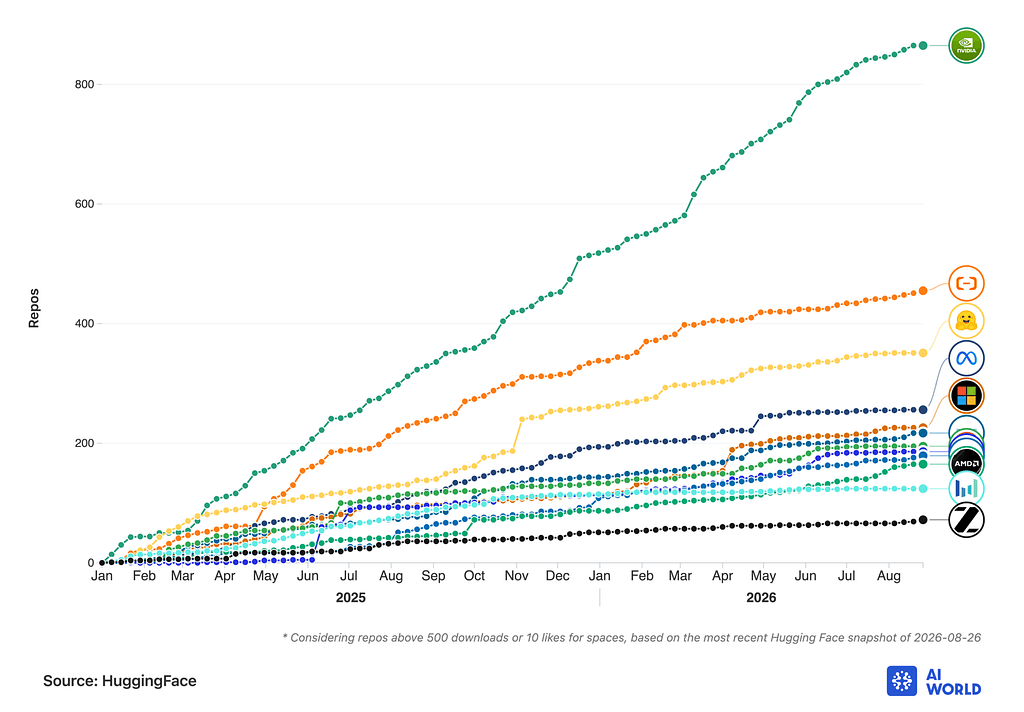
Ultimately, this acquisition places NVIDIA at the center of the AI development pipeline. By securing the primary repository where the global developer community collaborates, NVIDIA optimizes its hardware and software synergies, cementing its position as the foundational layer of the next generation of computing infrastructure.
Don’t forget to follow us to receive AI News updates directly in your inbox!
Prepared by:
BAU AIS — AI Publishing Committee
Team Member: Tolga Gülel
Resources:
Navier–Stokes Milenyum Ödülü Problemi Üzerine | OpenAI
NVIDIA to Acquire Hugging Face | NVIDIA Blog
Contact:
Mail: [email protected]
Instagram: Instagram Profile
LinkedIn: LinkedIn Profile
Originally published on Medium
Read on Medium